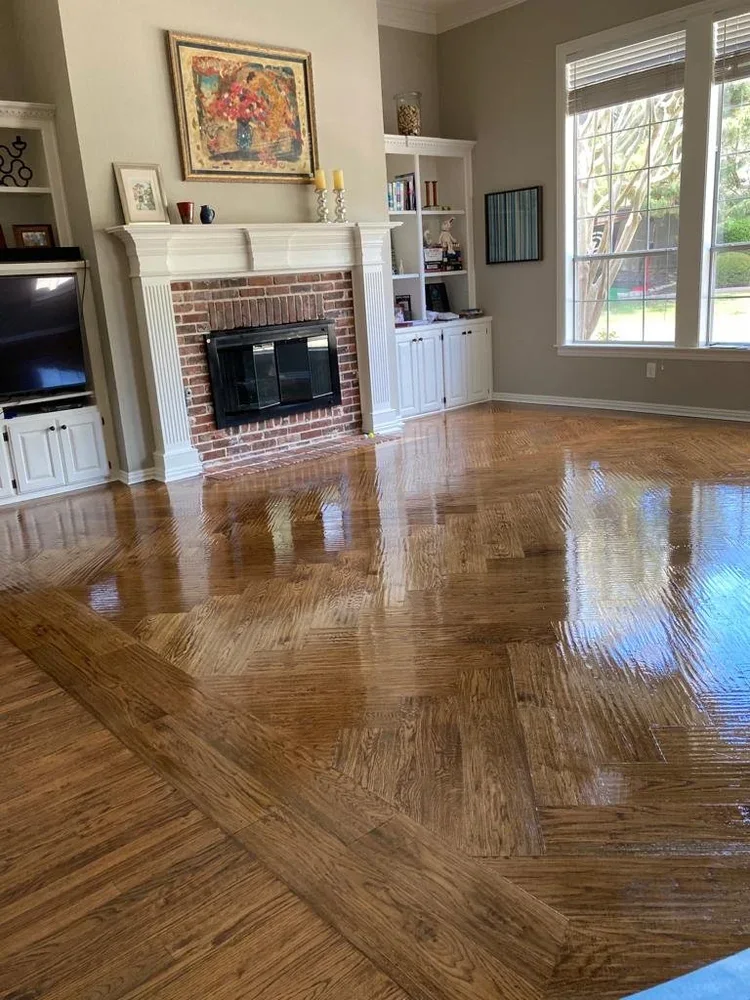
Worn hardwood floors force a familiar question: do you sand them back to life or tear them out and start over? For most Dallas-Fort Worth homeowners, the bottom line is simple. Refinish if the wood is structurally sound and thick enough to sand, which describes the majority of tired floors. Replace only when the damage runs deeper than a sander can reach, or when the wood is too thin for another pass. Refinishing also wins on money: it costs a fraction of replacement and returns about 147 percent of its cost at resale (National Association of Realtors, 2022 Remodeling Impact Report). This guide walks through the exact signs for each choice, plus the local soil factors that make the decision different here in North Texas.
Key Takeaways
- Refinishing is 2x to 4x cheaper. It runs $3 to $8 per square foot versus $11 to $25 for new solid hardwood installed (HomeGuide, 2026).
- Refinishing returns more. It recovers about 147 percent of cost at resale, beating new wood flooring at 118 percent (NAR, 2022).
- Thickness decides it. Solid wood refinishes four to six times over its life (Angi); engineered needs a 2.5 mm or thicker wear layer to sand (NWFA, 2022).
- Replace when damage is structural: water rot, termite loss, buckling, or wood sanded too thin.
What is the short answer: should I refinish or replace hardwood floors?
Refinish in most cases. Roughly four out of five worn floors we assess in DFW have sound wood that only needs sanding and a fresh finish, not demolition. Replacement earns its higher cost only when the boards are damaged beyond sanding, water-rotted, or worn too thin to cut again safely.
Think of it as a decision tree. Is the wood solid underfoot with no rot, buckling, or major movement? Is there enough thickness left above the tongue-and-groove to sand? If both answers are yes, refinishing is almost always the smarter spend. If either is no, replacement moves into the conversation. Everything below helps you answer those two questions with confidence.
How much does it cost to refinish vs replace hardwood floors?
Refinishing costs $3 to $8 per square foot nationally (HomeGuide, Modernize, 2026), and DFW pricing falls within that band. New solid hardwood runs $11 to $25 per square foot installed, with engineered at $9 to $20 (HomeGuide, 2026). That makes replacement roughly two to four times the price of refinishing the same room.
The gap is easy to underestimate. Replacement is not just new boards; it adds demolition, disposal, material acclimation, and installation labor, all stacked on top of the finishing step you would have paid for anyway. In our DFW experience, homeowners who assume the two options are close in price are usually surprised once the full replacement scope is itemized.
| Factor | Refinish existing floor | Replace with new floor |
|---|---|---|
| Cost per sq ft | $3 to $8 (HomeGuide, Modernize, 2026) | $11 to $25 solid, $9 to $20 engineered (HomeGuide, 2026) |
| Relative cost | Baseline | Roughly 2x to 4x more |
| Resale ROI | About 147 percent (NAR, 2022) | About 118 percent (NAR, 2022) |
| Typical timeline | 3 to 5 days work, 7 to 14 days to fully cure (National Floors Direct) | Longer: demolition plus acclimation plus install |
| Disruption | Lower | Higher |
Want the full breakdown by wood species and room size? See our hardwood flooring cost guide for detailed numbers.
When is refinishing the right call?
Refinishing is right whenever the wood itself is sound and thick enough to sand. If your floor's problems live on the surface, you almost certainly do not need new wood. Solid three-quarter-inch hardwood can typically take four to six full refinishes over its lifetime (Angi), so most floors have plenty of sanding life left.
On real DFW job sites, we have found that floors homeowners had written off as ruined were usually one sanding away from looking new. Surface problems read as damage, but they vanish under the drum sander. Watch for these signs that refinishing is your move:
- Surface scratches, scuffs, or dull, worn-through finish
- Light water spotting or staining that has not penetrated the wood
- Grayed or faded areas from sun and traffic
- Minor gaps or a few squeaky boards
- You want a new stain color without changing the floor
- The boards feel solid with no soft spots, movement, or rot
Here is what most guides miss: a floor can look terrible and still be an ideal refinishing candidate. Cosmetic wear and structural failure are different problems. The finish is sacrificial by design, meant to be renewed, so a beat-up surface is often just a sign the finish did its job. That work is the core of our hardwood floor refinishing service.
When does replacing hardwood floors make more sense?
Replacement makes sense when the damage is structural, not cosmetic, or when the wood is too thin to sand again. Sanding can erase a bad surface, but it cannot rebuild rotted, warped, or missing wood. In those cases, new flooring is the honest answer, and paying to refinish first would waste money.
Look for these replacement signals:
- Water rot or soft, spongy boards that give underfoot, often from leaks or slab moisture
- Warping, cupping, or buckling severe enough that sanding flat is not realistic
- Termite or pest damage that has hollowed the wood
- Deep gouges or a wear layer sanded too thin to survive another pass
- Widespread damage. As a rough industry rule of thumb, when more than about 30 percent of the floor is compromised, replacement often pencils out better than piecemeal repair
Solid hardwood lasts 30 to 100 years precisely because it can be refinished repeatedly, while engineered flooring typically lasts 20 to 40 years (Angi). If your engineered floor has already reached the end of a thin wear layer, replacement is usually the only path. Planning a full replacement? Our flooring installation team handles removal and new install.
The third option: partial repair plus a full refinish
Most guides treat this as all-or-nothing, but there is a middle path that saves floors every week: replace only the damaged boards, then refinish the entire floor so it blends seamlessly. This costs far less than full replacement and keeps your original wood where it is still sound.
This is the option homeowners rarely hear about, and it is frequently the best value. Say a kitchen leak ruined a dozen boards but the rest of the floor is perfect. Tearing out the whole room would be wasteful. Instead, a skilled crew weaves in matching boards, then sands and finishes wall to wall so the repair disappears into one uniform surface.
The catch is matching. Species, grain, and board width all need to line up, and blending old wood with new takes experience. That is exactly the work our hardwood floor repair service handles before a full refinish. When part of a floor is damaged but most is fine, ask about repair plus refinish before you agree to full replacement.
Can engineered hardwood be refinished?
Sometimes, and it comes down to the wear layer thickness. The NWFA Certified Refinishable program requires at least 2.5 mm (3/32 inch) for factory-finished engineered flooring and 3.2 mm (4/32 inch) for unfinished (NWFA, Hardwood Floors Magazine, 2022). Below that, sanding risks cutting through the veneer into the core.
Thin veneers around 1 mm, common in budget engineered products, cannot be sanded at all. They can only be recoated, meaning a fresh top coat over a light scuff-sand, with no color change and no scratch removal. That is a maintenance refresh, not a true refinish. Knowing your wear-layer thickness settles the refinish question for engineered floors.
How can you tell if a hardwood floor is too thin to refinish?
Check the wood where a cut edge is exposed, typically a floor vent, a doorway threshold, or a stair nose. As professional guidance, if roughly an eighth of an inch or less of wood remains above the tongue-and-groove, another sanding risks exposing the joint. At that point the floor has usually reached its refinishing limit.
Here is how we check it on a job site. We lift a heat register and look at the raw board edge, since that is the one spot you can see the full profile without pulling up flooring. Count past refinishes if you know them: each pass removes a little wood, and after four to six the margin gets thin (Angi).
Do not guess on this one. Sanding through the top of a solid board or the veneer of an engineered plank is a mistake you cannot undo. A flooring pro can measure remaining thickness precisely during an in-home assessment and tell you how many refinishes your floor likely has left before you commit to anything.
How does DFW soil and climate change the refinish vs replace decision?
North Texas is hard on wood floors in ways national guides ignore. The region's expansive clay soil swells and shrinks with moisture, and that movement transfers up through slabs and foundations into your flooring. Combined with wide humidity swings, it drives seasonal gapping and cupping that homeowners often mistake for permanent damage.
The subfloor type matters more here than almost anywhere. On slab-on-grade homes, common across newer DFW subdivisions, moisture moves up through concrete and can cup boards from below, which points toward addressing the moisture source rather than just replacing wood. On older pier-and-beam homes, seasonal crawl-space humidity drives the classic winter gaps that close up by summer.
Why does this matter for your decision? Because a lot of North Texas floors that look damaged in February are simply reacting to dry indoor air, and they recover on their own. Refinishing a floor that is mid-cycle can lock in gaps. In our DFW experience, the right call often starts with diagnosing moisture and movement first, then choosing refinish or replace once the wood has settled. Rushing to replace over seasonal cupping wastes money on a problem the weather created.
Which option wins on lifetime cost and resale value?
Refinishing wins on both. It recovers about 147 percent of its cost at resale, compared with roughly 118 percent for new wood flooring, and 54 percent of buyers say they would pay more for a home with hardwood (National Association of Realtors, 2022 Remodeling Impact Report). Few interior projects return more than a hundred percent, and refinishing clears it handily.
Stack that against the upfront math and the case gets stronger. You spend two to four times less to refinish (HomeGuide, 2026), and you earn a higher percentage back when you sell. Over a solid floor's 30-to-100-year lifespan (Angi), refinishing every decade or so keeps the same wood looking new for a fraction of repeated replacement cost.
The recommendation for most DFW homeowners
Refinish first, replace only when you must. If your wood is sound and thick enough to sand, refinishing delivers a like-new floor for a fraction of replacement cost and returns more at resale. Save replacement for structural damage, rot, or wood that is simply too thin for another pass.
The honest answer depends on your specific floor: its remaining thickness, the type and extent of any damage, and how North Texas moisture has affected it. That is a call best made in person, not from a photo. Bernard Hardwood Floors, family-owned in Irving and serving Dallas-Fort Worth since 1999, measures your wear layer, checks for moisture and movement, and gives you a straight recommendation with an itemized quote, whether that is a refinish, a targeted repair, or a full replacement.
Ready to find out what your floor needs? Request a quote or schedule an in-home assessment and get an honest answer before you spend a dollar.
Frequently asked questions
Should I refinish or replace my hardwood floors?
Refinish if the wood is structurally sound and thick enough to sand, which covers most floors with surface scratches, dullness, or minor stains. Replace only when damage runs deeper than sanding can reach, such as water rot, buckling, or a wear layer too thin to survive another pass.
Is it cheaper to refinish or replace hardwood floors?
Refinishing is far cheaper. National estimators put refinishing at $3 to $8 per square foot (HomeGuide, Modernize, 2026), while new solid hardwood runs $11 to $25 installed (HomeGuide, 2026). That makes replacement roughly two to four times the cost of refinishing the floor you already own.
How many times can hardwood floors be refinished?
Solid three-quarter-inch hardwood can usually handle several full refinishes over its life, commonly cited as four to six (Angi). The exact number depends on how much wood remains above the tongue-and-groove. Once you near that layer, sanding is no longer safe and replacement becomes the option.
Can engineered hardwood be refinished?
Sometimes. The NWFA Certified Refinishable program requires a wear layer of at least 2.5 mm (3/32 inch) for factory-finished and 3.2 mm (4/32 inch) for unfinished engineered flooring (NWFA, Hardwood Floors Magazine, 2022). Thin veneers near 1 mm cannot be sanded and can only be recoated.
How do I know if my hardwood floor is too thin to refinish?
Check the wood at a floor vent or a threshold where a cut edge is visible. If roughly an eighth of an inch or less remains above the tongue-and-groove, sanding risks exposing the joint. A flooring pro can measure it precisely and advise before any work begins.
Does refinishing hardwood floors add value when selling?
Yes, strongly. Refinishing existing hardwood recovers about 147 percent of its cost, and new wood flooring about 118 percent, while 54 percent of buyers would pay more for a home with hardwood (National Association of Realtors, 2022 Remodeling Impact Report). Few interior projects return more at resale.