
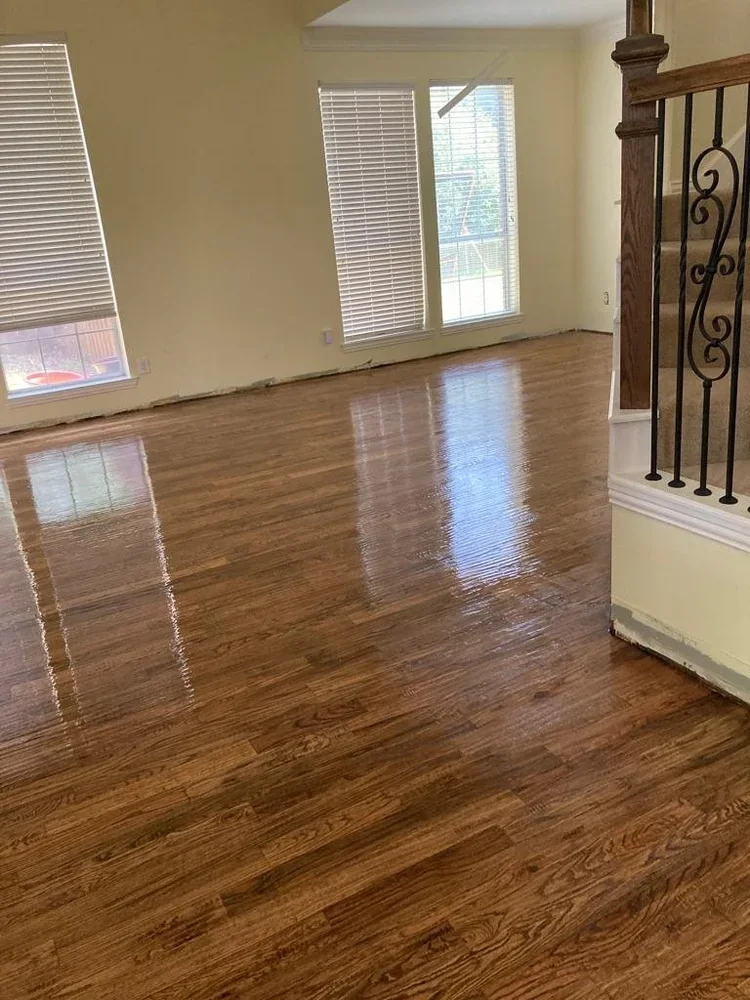
Choosing between engineered and solid hardwood? Here is the bottom line. Both are real wood. Solid wins on refinish count and total lifespan. Engineered wins on stability over concrete slabs and through humidity, which matters a lot in North Texas. The right pick depends on your subfloor, the room, and how long you plan to stay.
That last part trips up a lot of homeowners. A national blog will tell you one is "better," but the honest answer is local. Slab-on-grade construction, expansive clay soil, and swinging Dallas-Fort Worth humidity change the math. So before you fall in love with a species or a price, let us compare what actually holds up here.
Key Takeaways
- Both are real wood. Engineered has a genuine hardwood wear layer over a stable core.
- Solid refinishes 4 to 6 times and lasts 30 to 100 years (Angi). Engineered needs a 2.5 mm or thicker wear layer to refinish at all (NWFA, 2022).
- Engineered runs $9 to $20 and solid $11 to $25 per square foot installed (HomeGuide, 2026).
- Engineered handles concrete slabs and humidity better, a real advantage in DFW.
- New wood flooring recovers about 118 percent of cost at resale (National Association of Realtors, 2022).
Related reading: Hardwood Flooring Cost Guide and Refinish vs Replace Your Hardwood Floors.
What is the difference between engineered and solid hardwood?
The difference is construction, not authenticity. Solid hardwood is one solid piece of wood, typically 3/4 inch thick. Engineered hardwood is a real hardwood wear layer bonded to a cross-ply or plywood core. Both give you a genuine wood surface. The core is what changes how each floor behaves.
Solid hardwood: one piece, top to bottom
Solid wood is milled from a single board of oak, hickory, maple, or walnut. That thickness is the whole point. It leaves plenty of material to sand and refinish across decades. Because it is all wood, it expands and contracts with moisture, so it prefers a stable, above-grade wood subfloor.
Engineered hardwood: real wood over a stable core
Engineered flooring puts a slice of real hardwood on top of layers glued in alternating directions. That cross-ply construction fights the natural movement of wood. The result stays dimensionally stable through humidity swings and installs over concrete. Want the deeper install details? See our engineered hardwood installation page.
How do engineered and solid hardwood compare on cost?
Engineered hardwood usually costs a little less installed. HomeGuide reports solid hardwood at $11 to $25 per square foot installed and engineered at $9 to $20 per square foot installed (HomeGuide, 2026). Species, grade, plank width, and job complexity move both ranges. In our DFW experience, subfloor prep on slab homes is the biggest swing factor.
Price alone should not decide it. A cheaper engineered floor with a paper-thin veneer cannot be refinished, so it may cost more over 40 years than solid wood you sand and keep. Think in decades, not just the install invoice. Here is how the two stack up across the factors that matter most.
| Factor | Solid Hardwood | Engineered Hardwood |
|---|---|---|
| Installed cost (HomeGuide, 2026) | $11 to $25 / sq ft | $9 to $20 / sq ft |
| Refinishing | 4 to 6 times (Angi) | Only if wear layer is 2.5 mm or thicker (NWFA, 2022) |
| Lifespan (Angi) | 30 to 100 years | 20 to 40 years |
| Stability over slab / humidity | Lower, moves with moisture | Higher, cross-ply core resists movement |
| Best rooms | Living, dining, bedrooms above grade | Slab-on-grade, basements, over radiant heat |
Which can be refinished, and which lasts longer?
Solid hardwood wins on both. Because 3/4-inch solid wood can be refinished 4 to 6 times, it commonly lasts 30 to 100 years (Angi). Engineered hardwood lasts 20 to 40 years and can be refinished only when its wood wear layer is thick enough. This single factor, wear-layer thickness, separates a floor you keep for life from one you eventually replace.
The number that actually decides it
NWFA Certified Refinishable requires a minimum 2.5 mm (3/32 inch) wear layer for factory-finished engineered and 3.2 mm (4/32 inch) for unfinished engineered (NWFA, Hardwood Floors Magazine, 2022). Veneers near 1 mm can only be recoated, never fully sanded. So when you shop engineered, ask for the wear-layer spec in millimeters before anything else.
What refinishing buys you
On DFW job sites, we have sanded solid oak floors from the 1990s back to bare wood and watched them look new again. That is the payoff of thickness. A quality engineered floor with a 4 mm layer can take one or two sandings too. Learn what the process involves on our hardwood floor refinishing page.
Which handles concrete slabs and DFW humidity better?
Engineered hardwood handles both better, and in North Texas that is often the deciding factor. Its cross-ply core resists the expansion and contraction that swells and gaps solid wood. That stability lets engineered install directly over slab-on-grade, the foundation type in many newer Dallas-Fort Worth homes. Solid wood usually needs a wood subfloor above grade.
North Texas is tough on wood. We sit on expansive clay soil that shifts with every wet and dry cycle, and our humidity can swing hard between seasons. The same trait that makes engineered feel "less premium" to some shoppers, its layered core, is exactly what protects it here. On a slab in Irving or Frisco, engineered often outperforms solid despite costing less.
When a slab makes engineered the clear pick
If your floor sits on concrete, engineered is usually the practical answer. Solid wood over a slab requires a plywood subfloor or sleeper system, which adds height and cost, and it still moves more. Engineered glues or floats over slab cleanly. Compare that with our approach to solid hardwood floor installation on wood subfloors.
Which is better for each room?
It depends on the subfloor and the moisture. As a rule, solid hardwood suits living rooms, dining rooms, and bedrooms built over a wood subfloor above grade. Engineered hardwood suits slab-on-grade floors, basements, rooms over radiant heat, and higher-humidity spaces. Neither belongs in a full bathroom with standing water.
Go with solid hardwood when
- The room sits on a wood subfloor above grade.
- You plan to stay long enough to refinish more than once.
- You want the deepest sand-and-restore potential over decades.
Go with engineered hardwood when
- The floor is concrete slab-on-grade, common in newer DFW builds.
- You are installing over radiant heat or in a below-grade space.
- Humidity swings are a concern and you want maximum stability.
Does real wood flooring add resale value in DFW?
Yes, and this is where engineered and solid stand together. New wood flooring recovers about 118 percent of its cost, refinishing existing hardwood recovers about 147 percent, and 54 percent of buyers say they would pay more for a home with hardwood (National Association of Realtors, 2022 Remodeling Impact Report). Real wood, solid or engineered, is a strong resale asset.
Buyers and appraisers care that a floor is genuine wood, not whether the core is one piece or layered. So the resale question is not "engineered vs solid." It is "real wood vs a look-alike." Both engineered and solid count as the real thing, which is what protects your investment at sale time.
What do we recommend for DFW homeowners?
Choose by subfloor first, then by how long you will stay. If you are on a wood subfloor above grade and plan to keep the home for decades, solid hardwood and its 30 to 100 year lifespan (Angi) is hard to beat. If you are on a concrete slab or want maximum humidity stability, engineered is the smarter, often cheaper pick.
There is no universal winner, and any contractor who says otherwise is skipping the questions that matter. What is under your floor? How long will you live there? What is the humidity story in that room? At Bernard Hardwood Floors, we have answered those on real Irving and Dallas-Fort Worth job sites since 1999, and the right call changes house to house.
The best next step is an in-home assessment so we can check your subfloor and moisture conditions in person, then give you an itemized quote for the option that fits. Request a quote and we will help you compare engineered hardwood flooring and solid side by side for your space.
Frequently asked questions
Is engineered hardwood real wood?
Yes. Engineered hardwood is real wood. It has a genuine hardwood wear layer bonded to a cross-ply or plywood core. The core is what stays stable through humidity swings, but the surface you walk on and see is the same species as solid wood, oak, hickory, or walnut.
Can engineered hardwood be refinished?
Sometimes. Engineered hardwood can be sanded and refinished only if the wood wear layer is thick enough. NWFA Certified Refinishable requires at least 2.5 mm for factory-finished and 3.2 mm for unfinished engineered (NWFA, 2022). Veneers near 1 mm can only be recoated, never fully sanded.
Which costs less, engineered or solid hardwood?
Engineered usually costs a little less installed. HomeGuide reports engineered hardwood at $9 to $20 per square foot installed and solid hardwood at $11 to $25 per square foot installed (HomeGuide, 2026). Species, grade, and job complexity move both numbers up or down.
Which lasts longer, engineered or solid hardwood?
Solid hardwood lasts longer. Because 3/4-inch solid wood can be refinished 4 to 6 times, it commonly lasts 30 to 100 years (Angi). Engineered hardwood typically lasts 20 to 40 years, and a thicker wear layer extends that life closer to the top of the range.
Which is better over a concrete slab or in DFW humidity?
Engineered hardwood is better over concrete slabs and through humidity swings. Its cross-ply core resists expansion and contraction, so it installs on slab-on-grade found in many newer North Texas homes. Solid wood is usually reserved for wood subfloors above grade.
Does engineered hardwood add resale value?
Yes. Real wood, engineered or solid, is a strong resale asset. New wood flooring recovers about 118 percent of cost and 54 percent of buyers would pay more for a home with hardwood (National Association of Realtors, 2022). Engineered counts as real wood to buyers and appraisers.